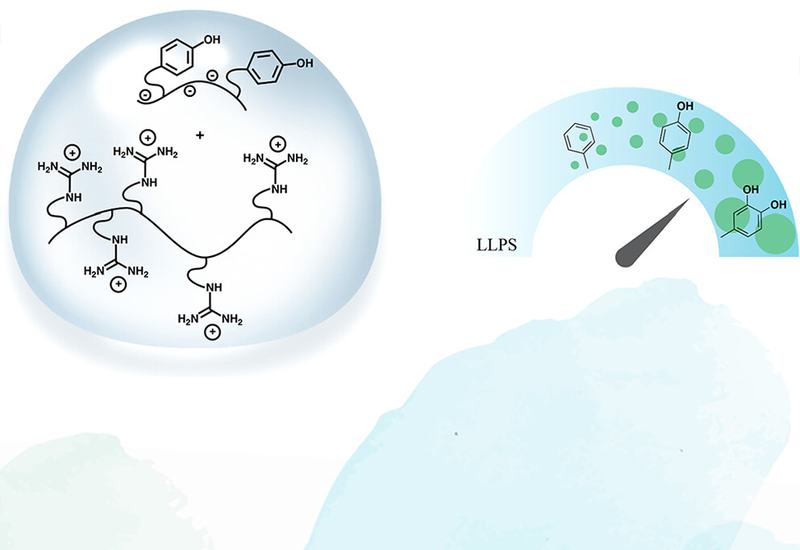
Biomolecular condensates, the membraneless organelles that concentrate proteins and nucleic acids inside cells, underpin processes from RNA splicing to ribosome assembly. Understanding what holds these assemblies together matters both for cell biology and for efforts to target condensate dysregulation in disease. For proteins in the FUS, fused in sarcoma, family, a 2018 consensus attributed condensate formation largely to cation–π interactions between arginine guanidinium groups and tyrosine aromatic rings. That consensus has shaped nearly every subsequent discussion of protein-mediated liquid–liquid phase separation, LLPS. Testing it rigorously has been difficult because ribosomal synthesis constrains which residues can be swapped globally across a protein domain.
Researchers in the Gellman Group at the University of Wisconsin–Madison and the Abbott Group at Cornell University, published in J. Am. Chem. Soc., developed a two-component system designed to circumvent those constraints. They paired a bacterially expressed 154-residue arginine-rich C-terminal fragment of FUS, designated FUS-C, with a chemically synthesized 28-residue tyrosine-rich peptide, 1(Tyr). Because the shorter component was accessible via solid-phase synthesis, the team could execute global residue replacements at all seven Tyr positions simultaneously, something impossible with purely ribosomal approaches. Mixtures of the two components underwent LLPS at low micromolar concentrations, confirmed by confocal fluorescence microscopy and dual-label colocalization of both partners in the condensed droplets.
Systematic replacement of the seven Tyr residues with noncanonical analogues produced a phase-separation propensity order of 5(DOPA) > 7(Cha) > 1(Tyr) > 3(F3Phe) ≈ 4(OMe) > 2(Phe) ≈ 6(diOMe), where DOPA is 3,4-dihydroxyphenylalanine, Cha is cyclohexylalanine, F3Phe is 3,4,5-trifluorophenylalanine, OMe is 4-methoxyphenylalanine, and diOMe is 3,4-dimethoxyphenylalanine. The ranking challenged the cation–π hypothesis on two fronts. First, 3(F3Phe), whose electron-poor ring is predicted to form weaker cation–π interactions than benzene in the gas phase, showed higher phase-separation propensity than 2(Phe), which bears an unsubstituted benzene ring. Second, 7(Cha), whose aliphatic cyclohexyl side chain cannot participate in any cation–π interaction, supported condensate formation at concentrations comparable to 1(Tyr) itself. Reverse-phase HPLC profiling of model tetrapeptides revealed that both F3Phe and Cha carry substantially greater hydrophobicity than Phe or Tyr, pointing to hydrophobic interactions as an alternative driver in those cases.
Replacing Tyr with 5(DOPA), which adds a second hydroxyl H-bond donor to the aromatic ring, roughly halved the minimum condensate-forming concentration to 2 μM and generated a condensed phase so cohesive that fluorescence recovery after photobleaching, FRAP, measurements indicated gel-like rather than liquid behavior. Replacing Tyr with 4(OMe), which retains the methoxyphenyl π system but eliminates the H-bond-donating hydroxyl, raised the minimum concentration from 5 μM to 14 μM. Replacing 5(DOPA) with 6(diOMe), which caps both hydroxyls as methyl ethers, collapsed phase-separation propensity to the level of 2(Phe). Quantum mechanical calculations at the MP2/aug-cc-pVTZ level with a polarizable continuum model for aqueous solution showed that phenol, anisole, and dimethoxybenzene form lithium cation–π complexes of nearly identical stability, with explicit water molecules producing energy differences well below the accuracy threshold of the method. Collectively, the experimental and computational data are inconsistent with cation–π forces as the primary condensate driver; instead, they implicate H-bond donation by the Tyr hydroxyl alongside Coulombic interactions between the anionic peptide and the cationic FUS fragment.
The authors note that because 1(Tyr) carries anionic Glu residues not present in the Tyr-rich domain of full-length FUS, which means that there is Coulombic component to interactions between the peptide and the cationic FUS fragment, some caution is warranted in direct extrapolation. However, the parallel behavior of their system and FUS upon global Tyr-to-Phe replacement supports the relevance of the conclusions to FUS family biology and to potential therapeutic targeting of condensate assembly in neurodegeneration and related diseases.